
resources for your journey through lent
Resources For Your Journey
Journaling Prompts (SOAP process) for any Scripture passage
Scripture Reading Plans (A walk through Romans, Living Loved)
Fasting Resource
Breath Prayer Resource
The Examen
Silence and Rest: Silent Prayer
Community
Scripture Reflection/Journaling Prompts
SOAP Process
S - Scripture: Read and write Scripture; look and listen. Open your Bible to the reading for the day. Ask God to reveal His word to you. Slowly read and allow God to speak to you; don’t rush. Look for a word, phrase, or verse that particularly stands out to you. Physically write out the Bible verse (or passage). You’ll be amazed at what God will reveal to you when you slow down to write or meditate on what you read!
O - Observation: What do you see in the verses? Some questions: What do you think God is saying in this Scripture? Who is the audience? In your own words, describe the context. Is there a repetition of words? What words stand out to you? Is there a command or warning? What is the main lesson or theme?
A - Application: When God’s Word becomes personal. Personalize the text by reflecting on how this applies to your life right now. What is God saying to you today? Write how God is showing you that this Scripture can apply to you today. How can I apply what I just read to my life? Are there any changes I need to make?
P - Prayer: Write a prayer. You might pray about what stood out; where He may be guiding; where you are grateful; where you might need His help. Don’t worry about getting the words right. If God has revealed an area of weakness, sin, or temptation, confess it to Him. He sees you, knows you and loves you. Jesus invites you to learn from Him.
~Adapted from Love God Greatly & CtK Charlotte
A Couple Lent Reading Plans
a journey through Romans during lent
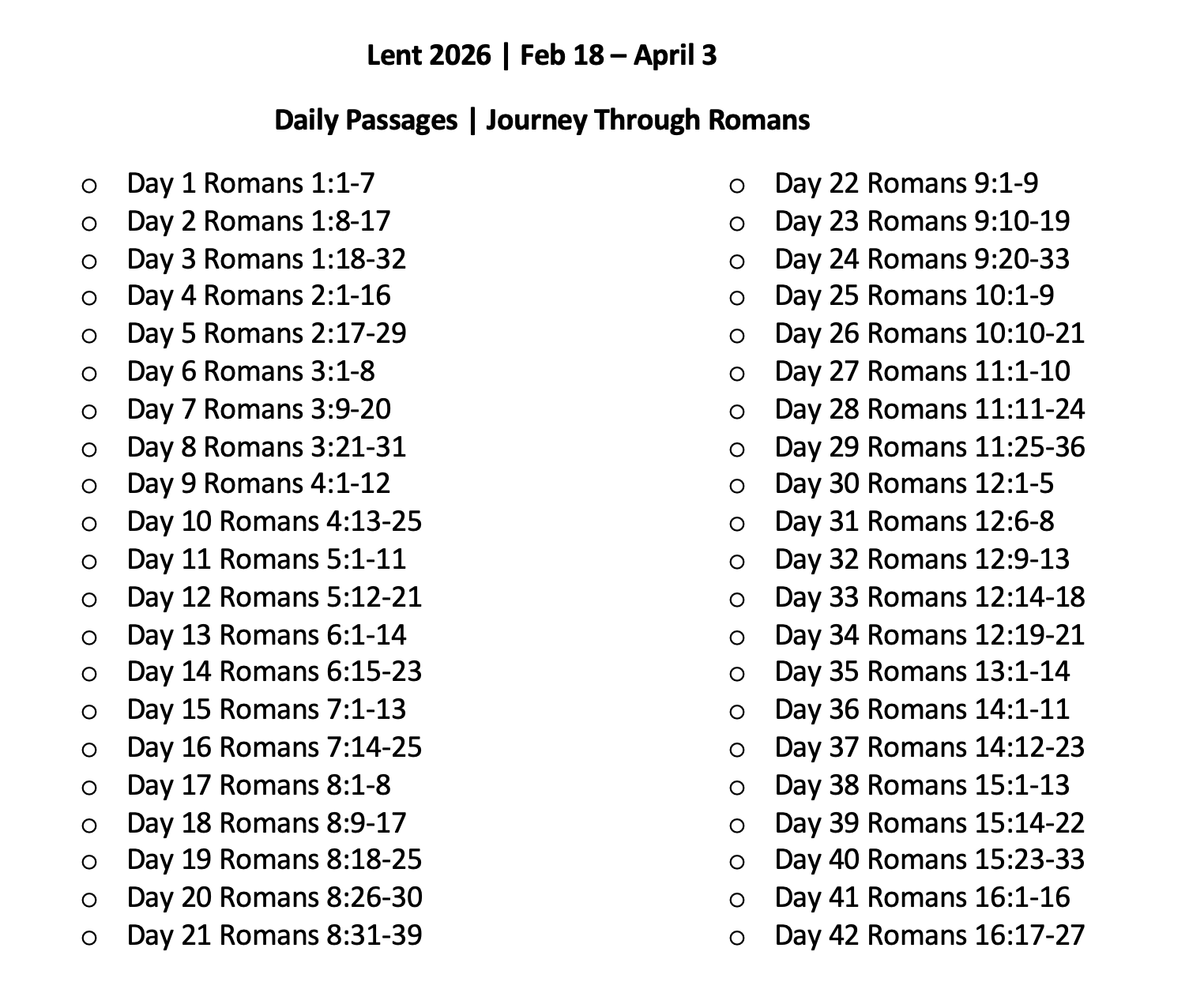
Living Loved Lenten Experience
Daily Scripture passages, audio, printables and other resources by Ann Voskamp. Available at: Living Loved
practices of Jesus | draw near
Lent: A Wilderness Journey with Jesus
After Jesus’ baptism by John the Baptist in the Jordan River, he was compelled into the wilderness by the Holy Spirit. Over a period of 40 days, Jesus fasted, connected with God, and was prepared for His ministry. He was tempted by Satan and resisted every temptation. Lent offers us an opportunity, an invitation to enter into a kind of wilderness with God. To open ourselves to Him, aim to become more aware of His presence with us and our dependence on Him. We invite Him to search our hearts and lives; show us anything that is out of alignment with His way; and guide us forward through His transforming power and presence.
The Bible in James 4 promises that as we draw near to God, He draws near to us. Psalm 23 reminds us that His goodness and mercy will follow us all the days of our lives. May we grow in awareness of His constant, loving pursuit and increasingly sensitive to His presence, voice, and movement in our lives and in the world around us through this time.
Each week during this Lent season, we will share practices of Jesus that help us draw near, to learn from Him, spend time with Him, and open ourselves up to His life-giving, transforming grace, power, and love.
2.18.26 | Fasting
As Jesus fasted in the wilderness, many followers of Jesus also fast in some way during Lent as a way to grow in dependence on God and increasingly more aware of His leading.
A Word About Fasting
You also might consider fasting during this time. The Bible provides countless examples of God’s people fasting and praying in times they were seeking His move and/or to hear from Him. Pray and see if God might lead you to fast during this time.
Fasting is a biblical way to grow closer to God so that we can hear him more clearly. It opens our hearts up for him to renew us, prepare us, and guide us.
Biblical fasting involves giving up something we need, rely on in some way, or eliminating things that distract us from God, AND replacing that time, focus, and energy with God. We fast to draw close to God, hear him more clearly, and depend on His power rather than our own.
Why consider fasting?
Fasting is a discipline Jesus practiced and prioritized from the beginning. We can learn from Him. When we fast from something that we often depend on—as fuel, a distraction, reward, escape–our dependence on God increases as we look instead to Him for strength, patience, peace, wisdom, satisfaction… instead of the “something” we usually turn to.
We remember: Jesus fasted and prayed in the wilderness after His baptism. God’s people throughout time also fasted and prayed, e.g., Daniel, King David, Esther, the prophetess Anna, Elijah, the apostles in the early church in Acts, along with many others. The Prophets taught about fasting; see Isaiah 58 and Joel 2. Jesus teaches about fasting in Matthew 6.
How/What to fast?
Pray for God to guide you. A few examples might include choosing to fast one meal a day or a day a week, if health permits; taking a break from social media, doom-scrolling, online shopping, electronic games, or streaming shows/Netflix binges; or eliminating extra sweets, caffeine, alcohol, etc. When we find ourselves instinctively turning toward the “something” we are fasting, we can turn instead to God in prayer. Over time, our dependence on Him grows, and we also grow to be more sensitive to His leading and His voice. Again, most importantly, allow God to guide whether and what to fast.
Want to learn more about fasting? Check out this resource from Practicing the Way.
God is with us, hears us, provides for us, and loves us more than we can even imagine!
How might God be leading you?
2.27.26 | Breath Prayer
Another way to connect with God is Breath Prayer and allow Him to quiet our hearts and minds. During breath prayer, we shift our focus and attention toward God and welcome Him in; we become more aware of His presence with us and affirm His promises.
Breath Prayer is a practice of praying that uses our normal, rhythmic breathing as the foundation for short, repetitive prayers that invite God into quiet or chaotic moments of our days. The process is simple and over time, can grow into an ongoing practice that helps us connect with God as we move through our days. It involves breathing in slowly while quietly repeating a chosen phrase, then slowly exhaling, focusing on the words of a second, related phrase. This practice of praying along with our breathing connects us meaningfully with God and invites Him into our lived experience.
How? We breathe in, focusing on a phrase, heart and mind toward God; then breathe out, quietly focusing on another related phrase, promise or invitation. Repeat a few times (3, 5, 7 or more), breathing in slowly; then out, slowly.
Words? You can choose a short Scripture passage or simply speak your own words of prayer. Use any passage that is meaningful for you or any prayer of your own. A couple of examples are below.
Psalm 27: [inhale] Lord, you are my light and salvation; [exhale] I will not fear.
Psalm 23: [inhale] The Lord is my shepherd; [exhale] I have all that I need. (Or I shall not want)
Psalm 63: [inhale] God, you are my God; [exhale] I thirst for you.
Practicing Breath Prayer: Now take a moment to draw near through praying a breath prayer. Sit quietly with God. Draw near. Breathe in and out, and allow yourself to settle. Now breathe in, praying your chosen words in connection with Him; then out, praying the second phrase, remaining connected with Him. Repeat…. knowing He is with you as you breathe Him in and out…
However you choose to journey with Jesus during this season of Lent, know that He is with you and we are praying for you.
3.12.26 | The Examen
The Examen is an ancient practice of self-reflection and prayer where we look back at a day and review and reflect on positive and negative moments we have experienced. The practice helps increase our awareness of God’s presence and active listening for His guidance as we move through our days.
A guided Examen prompts us to reflect on recent moments or events (both positive and negative); our inner responses to these moments; and to open ourselves to listen for God, identify what we might take into tomorrow, and pray a final blessing for God’s sustaining presence and peace. The primary components and process for Examen are outlined below. We encourage you to walk through this practice. The prompts below may help.
1. We quiet and place ourselves in the presence of our loving God. We still and quiet ourselves and seek the One who loves and sustains us, who created us. We seek His perspective on our lives, our responses to positive and negative moments, and see our experience through His loving eyes.
2. We give thanks. We reflect and grow in gratitude, thanking God for our lives and our gifts. This is essential in growing from a place of complacency or judgment toward gratitude.
3. We review recent moments of our lived experience. We look back at today or a recent day, even last week. We notice how God intersected our lives and how we responded, what we thought in the moments. We take note of feelings… and our responses. Did we pay attention and listen to someone who expressed a need – or dismiss them and re-focus on our own agenda? Did we notice the setting or rising sun as we drove from place to place…the beauty of nature? How did we love and care for those who frustrate us? We might take note of a particular phone call or text from a friend or family member. What happened externally (e.g., my words, actions, etc.) as well as internally (e.g., my thoughts, emotions).
4. Then we select a couple moments or experiences for reflection and hold them up before our loving God—who sees, knows and loves you. (1) One which was particularly positive, maybe even one when you noticed or sensed his presence; then listen… (2) Then perhaps a negative experience or moment: maybe one where I didn’t act like my best self (e.g., feeling or expressing anger, envy, fear, worry…); notice and express regret, ask God for forgiveness.. then pause, wait, and listen.
5. We look forward in hope. We look ahead, to His future guidance and provision. What is something we’ll take into tomorrow to apply next time? Or to remember. We anticipate His goodness. Over time, reflecting and praying through the Examen helps us look for and notice His activity in our lives and moments as we practice noticing what we did not notice before. We receive God’s blessing to carry us forward.
Prayer apps like Lectio 365 and others offer a variation on the Examen most nights as part of their evening time of reflection and prayer. These are guided prayers via audio.
3.20.26 | Silence and Rest: Silent Prayer
For some of us, as we move through these days, the concepts of silence and true rest might seem elusive, maybe even unrealistic. For others, this may be a season of extended quiet, even isolation. Yet, whatever your experience may be, what might it look like to intentionally sit in silence for a time, aware of the presence of Jesus, and to simply seek to rest awhile in Him? Could you carve out 10 minutes from your day? What if you accepted Jesus's invitation to come, enter into silence and simply to remain in his presence, to linger in expectation? A few minutes of quiet and rest for your heart, body, mind, and soul…
God invites us; scripture encourages us:
For thus said the Lord GOD, the Holy One of Israel, “In returning and rest you shall be saved; in quietness and in trust shall be your strength...” --Isaiah 30:15a ESV
For God alone, O my soul, wait in silence, for my hope is from him. He only is my rock and my salvation, my fortress; I shall not be shaken.
-- Psalm 62:5-7
Then Jesus said, “Come to me, all of you who are weary and carry heavy burdens, and I will give you rest. Take my yoke upon you. Let me teach you, because I am humble and gentle at heart, and you will find rest for your souls. For my yoke is easy to bear, and the burden I give you is light.” --Matthew 11:28-30 NLT
Wonder: What might Jesus do in 10 minutes spent together? Even 5 minutes?
Silent Prayer: What and How?
Silent Prayer is described by SoulCare as “a wordless way of resting in the presence of God. No words. No performance. No striving. Just presence.” It can be prayed any time. We quiet our minds and bodies to listen and rest in God’s presence, rather than fully emptying. We fix our mind, our thoughts, our awareness on God—Father, Son and Spirit: Jesus—the author and perfecter of our faith, our Heavenly Father, the Holy Spirit with us.
Set a timer for 10 minutes (or 5, whatever you have). Take a deep breath and slowly release the air. Do this a time or two. Quiet your mind - and thank God for being with you and offering real rest.
Now hit “start” on the timer, close your eyes and sit quietly, silently, aware of His presence. You might close your eyes to avoid distractions, if you would like. Any time you start thinking about anything other God, gently (without condemning yourself) return your attention to Him. Simply sit in silence, focusing on him, lingering, releasing, listening and resting. Allow Him to breathe life into you. He loves you. Whether or not you sense His presence in some way, know that He is with you and in you.
When the timer ends, take another deep breath through your nose, breathe out slowly through your mouth and quietly thank Him for your time together. Go in peace into the rest of your day, carrying with you this time with God who sees, knows, and loves you.
3.27.26 | Community
God connects us in fellowship and makes us a family in Christ. Community in and through Jesus is a gift of grace for His followers--to connect with one another in fellowship, grow and encourage one another spiritually in relationship with Jesus and each another; to experience God’s Word, presence, and healing as we grow to live in the freedom Jesus offers.
One of the core values of our church centers on engaging in Community through authentic, life-giving relationships. Why do we value Community? Community was a lived experience and core practice of Jesus and His disciples. They shared in life, served together; worshiped, learned and grew together; and encouraged and challenged one another.
When we form authentic, life-giving relationships with other followers of Jesus, gather and share in life and His word and worship together, we are forming the foundation for Community. How are you finding community in this season?
Small Group Bible studies aim to foster Community. Amid busy, or otherwise limiting life seasons, it can be challenging to prioritize connection with others in Community. Pray for God to guide. What other opportunities might God provide through your days and weeks?
Eastertide gatherings after worship on Sundays (April 12-May 17) will provide a new weekly opportunity for fellowship, connection, prayer, and sharing in a meal together. We look forward to seeing all God has planned and will do in and through this time.
God has designed us for Community. In Community, we prioritize connection and follow Jesus’s example to engage with compassion, kindness, grace, humility, and patience in Christ as we welcome and connect with others, and share in life and His word. He guides us to cultivate relationships bound by love, sharing in joys and burdens, encouraging one another, praying, bearing with and forgiving one another, making peace, and seeking unity and wholeness through the Holy Spirit. It is our hope that you will experience authentic, life-giving community as you journey ahead. Community is closer than you might think!
“Community is a gift of grace, through and in Jesus Christ.” –Dietrich Bonhoeffer
God invites us into Community; Scripture encourages us:
How good and pleasant it is when God’s people live together in unity! --Psalm 133:1
They devoted themselves to the apostles’ teaching and to fellowship, to the breaking of bread and to prayer... Every day they continued to meet together in the temple courts. They broke bread in their homes and ate together with glad and sincere hearts, praising God and enjoying the favor of all the people. --Acts 2:42,46-47a
Always be humble and gentle. Be patient with each other, making allowance for each other’s faults because of your love. Make every effort to keep yourselves united in the Spirit, binding yourselves together with peace. -- Ephesians 4:2-3
Therefore, as God’s chosen people, holy and dearly loved, clothe yourselves with compassion, kindness, humility, gentleness and patience. Bear with each other and forgive one another if any of you has a grievance against someone. Forgive as the Lord forgave you. And over all these virtues put on love, which binds them all together in perfect unity. Let the peace of Christ rule in your hearts, since as members of one body you were called to peace. And be thankful. Let the message of Christ dwell among you richly as you teach and admonish one another with all wisdom through psalms, hymns, and songs from the Spirit, singing to God with gratitude in your hearts. And whatever you do, whether in word or deed, do it all in the name of the Lord Jesus, giving thanks to God the Father through him.
--Colossians 3:12-17